How do bacteria actually find host cells when moving close to a surface?#
Motility is one of the key tools bacteria use to explore their environment. My research focuses on what happens when bacteria, like E. coli and Salmonella, move near surfaces such as host tissues—the critical step for starting an infection.
Is infection just random, or do bacteria really chase host cells? What about chemotaxis?#
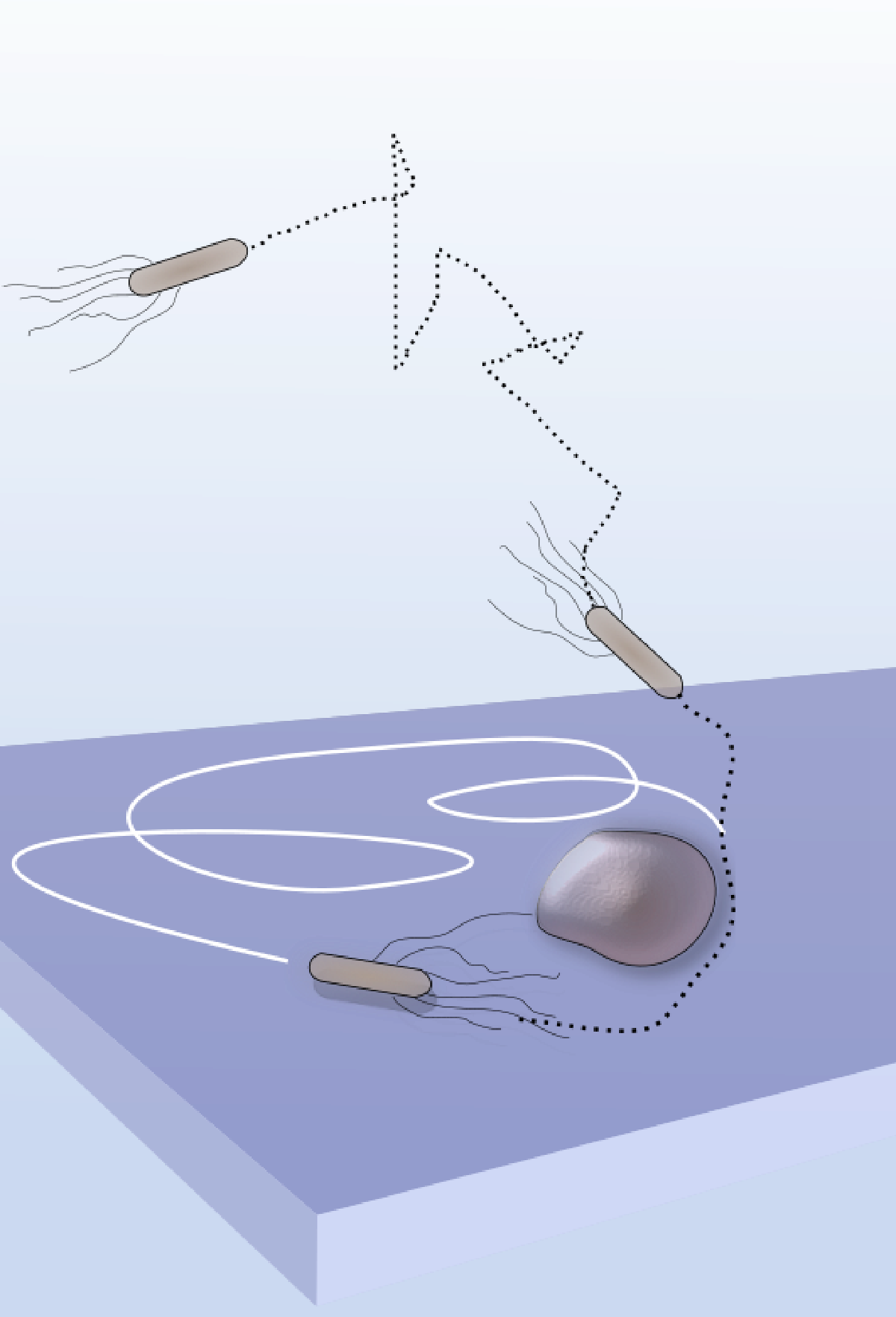
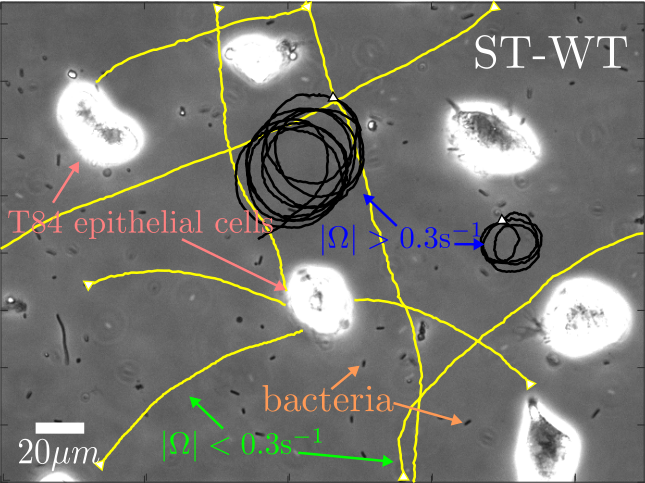
Bacteria are well known for chemotaxis—following chemical signals to move towards food or targets. In bulk liquid, this strategy works well. But near surfaces, it gets complicated. At the surface, bacteria like E. coli don’t always move straight towards host cells. Their movement becomes circular due to physical effects, and classic chemotaxis doesn’t function in the same way.
What is really interesting—and a main focus of my research—is that E. coli and other bacteria show a special kind of movement when close to surfaces: the stop and go dynamics. They swim for a while, then stop and briefly adhere to the surface before starting again. Our results suggest that the bacteria regulate how often they stop, and that there is an optimal stopping frequency which maximizes how fast they explore the surface (their surface diffusivity). This “stop and go” strategy is not random: it seems to help bacteria scan the surface more efficiently and could be a way to recover some ability to bias their search towards host cells, even when classical chemotaxis is suppressed.
Why does this matter?#
Understanding this stop and go motion is important because it reveals a possible mechanism bacteria use to increase their chances of successfully finding and infecting host cells. It also explains why infection in these conditions often appears random, but is actually driven by clever search strategies evolved by the bacteria. These dynamics are a big piece of the puzzle for knowing when and how infection starts.
What does this tell us about microorganism motility and the environment?#
My broader research tries to connect motility of microorganisms with the physical and chemical environment. Chemotaxis is only one aspect—physical structures, surfaces, and the ability to stop and stick also play a huge role. I am interested in how all these mechanisms combine in real infection scenarios, and how bacteria can adapt their strategies depending on where they are.
Key questions I am working on include:
- How do bacteria optimize their surface movement and search strategies?
- What is the real impact of stop-and-go dynamics for infection and for chemotaxis?
- Can understanding these strategies help us find new ways to fight bacterial infections?
I believe the way bacteria move and interact with their environment is a rich and fascinating topic, with important consequences for health and disease. My goal is to keep uncovering how these small organisms use clever movement strategies to survive and infect.
Otte, S.Ɨ, Perez Ipiña, E. Ɨ, Pontier-Bres, R., Czerucka, D., & Peruani, F. (2021). Statistics of pathogenic bacteria in the search of host cells. Nature Communications, 12(1), 1-9 link. Ɨ co-first authors
Perez Ipiña, E., Otte, S., Pontier-Bres, R., Czerucka, D., & Peruani, F. (2019). Bacteria display optimal transport near surfaces. Nature Physics, 15(6), 610-615 link.